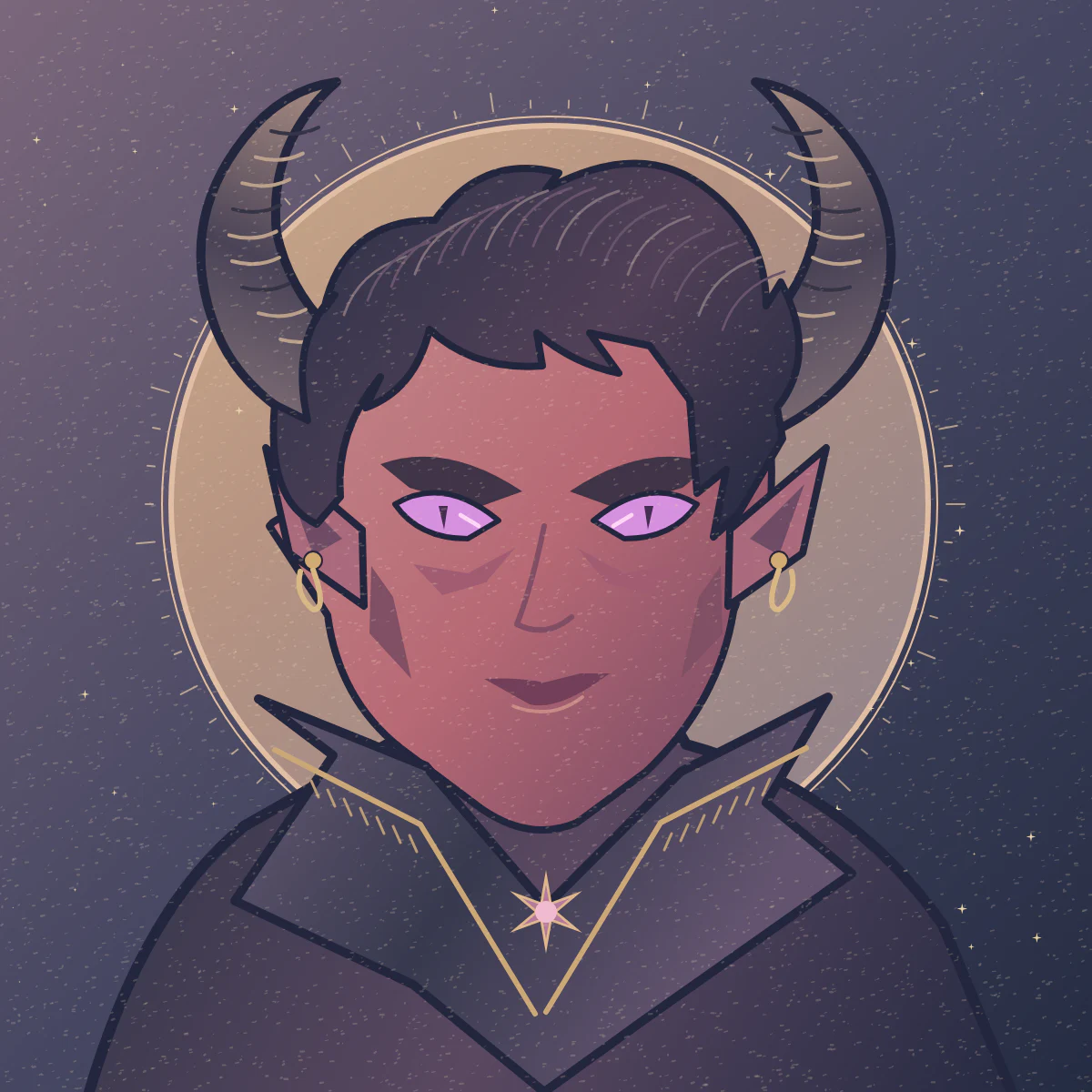
How do you fit a character into a round token?
- 01
Describe a close-up
Center the face and give it one distinctive feature.
- 02
Choose the ring
Compare the ring finishes against the character’s hair and armor.
- 03
Export the token
Save the 400 × 400 PNG and check its transparent corners.
Which features distinguish two NPCs at the same map scale?
A bust portrait leaves more space for eyes and expression than a full-body drawing. Put the most distinctive detail near the face. A crescent-shaped scar will survive the crop more easily than a sword tip at the edge of a cloak.
Try two character briefs that remain recognizable even when their colors appear similar. Use the direction of the ears, jawline or headwear as a second cue. Inspect both inside the circular crop and at one cell on the same map before choosing border finishes.
- Harbor lookout
- A weathered owl with one broken feather on its left ear tuft, an amber eye and a dark blue collar. Frame the head close to the center and leave a little space above both ears.
- Archive keeper
- A narrow-faced badger wearing oval spectacles and a folded green cloth cap. Light the lenses from one side so they do not obscure the eyes. Show the head and shoulders straight on for a small tabletop marker.
Will the token read on the encounter map?
Test the portrait at one cell in your usual tabletop view. A gold ring may stand out on dark stone but disappear on sand. Choose the frame against the map where the party will actually meet the character.
| Visual check | Try on the map |
|---|---|
| Face | Reduce to one cell and decide whether you still recognize the eyes, muzzle or mask. |
| Silhouette | Move the token across pale and dark terrain to see where the rim disappears. |
| Corners | Check that the ground remains visible around the circle rather than showing a solid square tile. |
Which size should you use in your VTT?
The downloaded PNG is 400 pixels square. Set the world-space dimensions in your tabletop. A giant and a halfling can use files with exactly the same pixel dimensions and occupy different numbers of map cells.